• Home
  • Authored and Edited Books
  • Articles and Chapters
  • Book Reviews and Notes
  • Other Professional Writing
  • In Progress
  • Contact

Steven Michels

  • Show Me Your Knowledge: An Interview with Rick Magee

    August 10th, 2016

    Rick Magee is an associate professor of English at Sacred Heart. He won the Excellence in Teaching Award in 2015 and has a reputation for being one of the most effective and most popular instructors on campus. I wanted to see what he was up to, so I could steal some of his best ideas.

    I’ve heard many students comment that your courses are remarkable for how much the students have a say in how they are run. How do you incorporate student feedback or choice into your course design?

    Last Spring, I picked up an anthology—we stared off with one novel—and I had some secondary readings that we talked about to establish our theoretical framework for the class, to give them the vocabulary and all of that. Then I said: “Here’s the anthology. Every week you are going to pick out the reading and break up into groups. Every group was going to do two readings, based on how people there were in the class and how many weeks we had, and you’re going to teach the class that day”—so they did it.

    I thought that worked surprisingly well. I also said: “How do you want to be assessed? How do you want me to find out what you’ve learned? Here are some things that I’d like to see. I want to see this and this and this. What would be the best way to be able to do that?”

    One of my students who is an English major who had had me before said, “I really like the micro-essay,” which is a very focused, super short close reading of about 250-300 words, where, for example, they have to find one word in the essay and analyze it.

    How are the micro-essays different from what might be called a standard essay? And what other kind of writing do you have them do?

    I had students who still tried to write a 5-paragraph essay, but I told them to get rid of all the unnecessary introductory material because it’s all throat clearing. It’s all fine, but that’s the prewriting and you get rid of that in your final draft.

    We had a couple of papers like that due, then I said: “I want to have you do something that shows me that you got something out of the class. Show me that I’m not wasting my time. I don’t know what we’ll call this. And one student said ‘Let’s call it “Show Me Your Knowledge,”’ and I said, “‘Ok, cool.’

    “And it can be anything,” I said. “Play to your strengths. If you’re a short story writer, then write a short story. If you’re a painter, then paint me a picture. Just show me that you learned something—somehow.” And they were panicked about that. Complete panic. For the last class, they all had 5 minutes to show their projects, and everyone did really, really well.

    I was really careful not to tell them “This is what I want you to do,” but I said, “Come to me with an idea because I’m not going to tell you what you should do.’”

    This semester I collected all the readings from a lot of places, but they were in charge of whatever we talked about in class. Having them lead the discussion is less-pressure version where you ask a question and wait for someone to answer it. It put enough pressure on them or we’d sit around and stare at each other till someone said something.

    Last semester, they lead everything. If they came to some big idea and I saw how I could insert something I would jump up and scribble on the board and we’d talk about it. And then some of the students would try it on their own in the essays and have fun with that.

    Do you spend a great deal of time selecting materials? You certainly offer what I would call cool courses—the “It’s the End of the World (As We Know It)” on dystopian literature or the course on nature.

    I have to go back to my own undergraduate courses. I loved reading trash, all through childhood and high school. I would read trashy spy novels by Robert Ludlum, and I was a huge Stephen King fan. Then I got to college and it was—Oh, you don’t talk about that stuff because it’s like some shameful secret that you read these guys. You don’t dare let anybody know. And that was a real turn off. Even in grad school, I remember there being other grad students who would play the sophisticated card, and I decided that was just a bunch of bullshit.

    Reading is not supposed to be this onerous task. It’s fun, that’s what I have 10,000 books at home. So I try to exhibit that. Students have a very regimented, factory notion that if it isn’t in this fancy leather-bound volume, then we can’t talk about it.

    I taught The Walking Dead, the graphic novel, and we watched most of the first, pilot episode in class. Both of my First-year Seminars were both on the quiet side, but toward the end I asked them to pick out one of the panels or images in the graphic novel, and we just talked about it. They were doing some really sophisticated reading of symbols—for example, what’s in the foreground versus the background and how things are shaded differently and how the art is conveying a message. They can do it; they just don’t think they can. Or they don’t think it’s something they need to know how to do.

    What about technology? How do you incorporate that into your courses?

    I’ve gone back and forth. I feel that I’m not using it as much as I should. I use Blackboard. I have them submit their papers electronically. I encourage them with the final projects to use it. I have students editing videos and things like that. Two of my current students put together an 18-minute video of their time in Vermont on the Appalachian Trail—it’s hilarious, it’s well done, it’s well edited.

    I also put a great number of links to news stories and blogs and videos. Especially when I’m doing something like the apocalyptic class, there’s always a news story that uses the term “apocalypse” or something like that, and I’ll talk about it a little in class.

    How do we develop an atmosphere where students feel free to express their opinions, even with or especially when they disagree with us?

    I feel like you can over prepare. When I over prepare, when I think that I have everything figured out about a text, it doesn’t work. But if I go in and say, “Here’s what we’re going to talk about,” then it works. Once a few students start to say something, more often than not, it’s not something I was planning on saying, but it’s a cool idea. Then I’ll write it up on the board.

    It’s not them disagreeing with me, but it opens up the space where they feel that they feel that their voice is being heard and that they can say something legitimate.

    Closely related to that is the idea that a lot of students have that the line between literary analysis and BS is non-existent. I’ve had a lot of students say, “I just wrote a bunch of BS,” and I have to say, “No, this is actually really good analysis. You were looking at the text and asking ‘What does that mean?’ You were making it up, but you were basing it on the text, and that’s what literary analysis is.”

    They’re taken aback by that because they think there is an actual answer. I think a lot of high school teachers teach literature as if it’s a puzzle to figure out—“What does this symbol mean?” and “What does this theme mean?” and that the text is some kind of lock that you have to pick.

    In literature, readings are layered. If you peel it back, you get another reading. If you peel that back, you get something else. And they’re all added together, and that’s why literature is so rich. All of these readings work, and they can contradict each other.

    All or mostly all of the students are capable of doing that, but many of them won’t realize that they can do it. They also don’t think that they’re allowed to express that they don’t like something. You don’t have to like everything you read, but you have to like it respectfully. Tell me why you don’t like it.

    Could you give an example of something that you tried that didn’t work and what you learned from it?

    I’ve tried to do debates. Maybe I don’t have enough training on how to set it up, but it’s tough to do with literature. What I’ve learned is that the debates are too binary, for one thing, and binaries just don’t work in literature. Sometimes they don’t want to disagree—it’s not polite.

    One other thing that I’m contemplating, and not necessarily because it’s failed, and that’s the research essay. “Go to the library and find a bunch of sources and use them”—I don’t think that model works very well. What I end up doing in a lot of my classes is to do what I do as a professional, and I don’t think that necessarily helps them. The idea that they’re supposed to engage in the conversation, but that’s not what a research paper does.

    I’m thinking I might explode that and have them do an annotation of once source. Then have them use the ideas that they learn from that source to write an essay about a work of literature.

    How has your teaching changed since you first started?

    I was a disaster. I started teaching as a grad student in 1993. Sometimes I feel like I should find all the students that were in my first classes and pay them back. I had the worst student evaluations I ever had. I had a letter of resignation ready to go, and I was ready to drop out of this writing program. I thought I would do it one more time, then everything changed.

    I was very gung-ho, that we have to do this Big Thing. I realized that I wanted them to be way up here, and they’re coming in here. I’m not going to drag them up to that high level. And I learned to take myself a little less seriously, and I think that helped a lot. In the last ten years, I’ve started to feel like I kind of know what I’m doing.

    I’ve also become less defensive about English. It’s easy to be really defensive about English because we get marginalized all over the place. I don’t worry about that as much any more. I know that it’s important. At the same time, it’s a safe place to stretch your intellect.

  • For Students: A Brief Guide to Success

    April 23rd, 2016

    Before considering some of these techniques, it’s important to dispel a couple of myths. For one thing, there’s no such thing as “fixed intelligence.” Some people might have an easier time with math or the piano, but everyone can learn, provided that they commit to it.

    In her book Mindset: The New Psychology of Success, Carol Dweck examines the importance of having a growth mindset. “The view you adapt for yourself profoundly affects the way you lead your life,” she writes. “It can determine whether you become the person you want to be and whether you accomplish the things you value.”

    Moreover, as cognitive scientist Daniel T. Willingham has shown, “learning styles” do not exist. It’s true that you might prefer one method to another or one subject to another, but when it comes to learning, the most important thing to know is that it requires regular and focused practice. As Cal Newport shows in his book Deep Work, attempting to multitask is counterproductive. The key is to focus without distraction.

    You need to be precise and practice particular activities, the kind that you will be expected to demonstrate on an exam or assignment. One of the best things you can do is practice retrieving information. Flash cards, for example, work to build information networks in your brain, which you can later access with ease. There are a number of good electronic ways to do this, including the Flash Card Machine, which is free and allows for sharing.

    You should also practice more difficult skills, like analyzing what you’ve learned and applying it to new situations and across courses. Here’s a great definition and overview of critical thinking that you might find helpful. Even if you’ve moved on to new material or a different module, you should review what you’ve learned. As Dustin Bakkie puts it, “The best time to learn something is right as you’re about to forget it.”

    Here’s a video on five different ways to take good notes. The “mind map” method works very well as a pre-writing exercise for papers. When deciding between pen and paper or computer, you should know that research has found that people retain information better when they take notes by hand.

    In addition to the how, there is also the question of how much studying. Indeed, “time on task” is one of the greatest predictors of student success. The “Carnegie Rule” is that you should spend 2-3 hours a week studying for every hour you are in class. Not every course will be this demanding, but many of your professors are operating under the assumption that you are a “full-time student.”

    One big difference between high school and college is the amount of unscheduled time you have. Most of your work will be done out of class, which means you need to have strong time management skills and an ability to prioritize your activities. Managing your time properly will ensure that you can attend classes prepared. You will get more out of class, if you know what everyone is talking about and you can contribute with informed questions and comments.

    David Allen, the author of Getting Things Done: The Art of Stress-free Productivity, which has become a movement of sorts, offers five steps for productivity: (1) writing down everything you have to do, (2) identifying the actionable steps, (3) organizing those activities by category and priority, (4) frequently reflecting on your list, and (5) remaining engaged.

    You should also keep a calendar that is accessible from your mobile phone that you refer to and update frequently. At the beginning of each semester, you should add all of the key dates for your courses and assignments—and refer to the syllabi regularly. It contains important information about assignments and expectations that you might not remember from the first day of class.

    Todoist a free app to organize your projects and tasks, when merely putting them on your calendar is not enough. Many people use the Evernote webpage/app for notes and lists. It’s free, flexible, and integrated into other programs, apps, and websites. You could use Google Docs in the same way. Its formatting makes it simple for writing papers, and since it’s cloud-based, you never have to worry about losing your work.

    Stephen Covey, author of The Seven Habits of Highly Effective People, suggests you keep a to-do list that’s organized around how important things are and when they are due. It’s inspired by Dwight D. Eisenhower, the president and general. Most people are prone to spend their time working on things at the last minute, then are too exhausted to do anything other than waste time on unimportant activities. The trick is to maximize the time you spend on important but not urgent work.

    If you struggle with time management, you might want to check out “How To Avoid Procrastination for Good” or “The Science of Procrastination” video for a number of effective techniques. You could also keep a log of all your activities for a couple weeks to determine if you are using your time wisely.

    If you’re concerned about writing, you should make heavy use of the Online Writing Lab (OWL) at Purdue University and Writing for Success, a free open-access grammar and style handbook. Grammarly is an excellent Chrome extension that helps with spelling and grammar in email and websites.

    With a Youtube channel, a blog, and a podcast, Collegeinfogeek.com is another great resource for serious students.

    Finally, you should visit your professors in their offices early in the semester and again later, as the need arises. The same is true of support services around campus—your advisor/s, the research librarians, the Learning Center, etc.

    There are a great many people on campus wanting to help you succeed. Most times, however, it’s easier for you to find them than it is for them to find you.

  • Big Learning

    March 21st, 2016

    James Lang, the author of four books and a regular contributor to The Chronicle of Higher Education, has just published a remarkable new book on teaching and learning, called Small Teaching: Everyday Lessons from the Science of Learning.

    Lang, professor of English and director of the Center for Teaching Excellence at Assumption College, takes his inspiration from baseball, specifically the term “small ball,” which emphasizes doing all of the little things well, rather than swinging for the fences. His approach is in large part a recognition that faculty, especially part-time faculty, are busy and often not in a place to make large-scale changes to their course design. It is far better to make incremental improvements and have your teaching evolve, than attempt something massive or, worse yet, avoid making changes at all because of the time cost.

    Although the book is informed by the latest psychological and pedagogical research, it’s highly engaging and accessible. In the span of one page, Lang references the latest academic research, Aristotle, and ordering tea from his local barista.

    Here’s a distillation of Lang’s suggestions, which correspond to its chapters: 

    1.     Give students frequent opportunities to retrieve what they have learned.

    2.     Ask students to make predictions prior to learning will increase their ability to process that material.

    3.     Space out learning and mix up the practice of skills (“interleaving”).

    4.     Use prior knowledge to help students make connections and expand their networks of
    knowledge.

    5.     Break down what you want your students to do into small and specific tasks and give them feedback on those tasks.

    6.     Have students explain what they are doing and why they are doing it, especially at the mid- and advanced stages of development.

    7.     Appeal to your students’ willingness to help other people and make a contribution to their community and the world (“self-transcendence”).

    8.     Communicate with your students in a way that praises effort over natural ability to foster a growth mindset.

    9.     When you’re ready for some big teaching, consider more activity-based learning, such as service learning, games, and simulations. 

    As part of his emphasis on the fundamentals, Lang offers a powerful corrective for two common practices (and errors) in higher ed. For one thing, he worries that we are too taken with Bloom’s taxonomy, specifically the notion that we should be spending as much time as possible on higher order skills such as evaluation and synthesis at the expense of more basic and essential skills like remembering and understanding. Regrettably, I am guilty of this. This is the premise behind Lang’s first principle: maximizing the “retrieval effect” will mean students have more knowledge to apply, when they get to that point.

    Lang is also concerned how flipping courses—that is, having students’ first exposure to material occur before class meetings and saving class time for more difficult work—has not been matched with making good use of class time, an issue that the tips from Lang’s book will certainly help with.

    If there is one essential lesson of the book, it relates to how we start and end our classes, which Lang discussed in two recent articles for The Chronicle. The open of a class should have students reflect on prior learning and prepare them for what’s to come, just as the last few minutes of a meeting should be used for reflection and to seal what has just been covered.

    Also noteworthy is the extent to which Lang seamlessly interweaves lessons for onground and online teaching. He firmly recognizes how commonplace online and blended courses have become for teachers and does not treat them as an afterthought, as we find in many other treatments of the subject.

    The great virtue of the book is that it speaks equally to novice and seasoned teachers. Even if it’s just getting in the habit of showing up to class 5-10 minutes early to make connections with the more reserved students, it’s impossible to read Small Teaching and not come away with something that can help your teaching tomorrow.

    Lang’s hope is that small teaching can lead to some big learning.

  • Using Slack as a Teaching Platform

    March 21st, 2016

    After hearing about how the communication platform Slack is taking over the business world, I decided to see what all the buzz was about, with the hope that I might use it for some administrative tasks. The platform seemed a little too involved for the standard academic committee, but I was delighted to see that I could adopt it for my online courses.

    The discussion board is really the heart of an online or hybrid course. For years, I’ve been using Google Blogger linked into Blackboard, rather than using Blackboard’s clunky and uber-clicky discussion board.

    The great virtue of Slack is how simply and intuitively it uses the discussion format as the basis for how it works. It’s more like Facebook and Twitter than Blackboard. It even seems fun–something no one has ever said about Blackboard.

    Here’s how I’ve it set up for my Political Psychology course.

    The Channels
    Rather than having a closed drop-down menu, Slack is organized around a series of open, user-created channels. The “starred” channels function the same as regular channels, but starring them sets them apart at the top, which makes it ideal for administrative purposes. I’ve set up three.

    The first (“info”) works like an announcements tab, which I use for course information, like explanatory videos on the syllabus and how to use the platform. Slack can be synced with Dropbox to upload documents, but I just posted and pinned the “share” link from my syllabus in Dropbox, so students can easily find it at any time.

    I set up a special Google calendar for the course and installed the Google calendar app on the “calendar” channel, which allows for daily updates on activities and reminders I can set up for specific deadlines. The “members” channel is where students and I introduce ourselves. The fact that Slack permits users to create profiles (with pictures) makes it especially good for online courses, where students can sometimes feel removed from their colleagues.

    The “starters” channel (shown below) is for the initial overview and summary of the materials I’ve selected for that week (aka, the lecture). The first week includes an overview of the history of the disciplines for the course and a TED Talk on the economic decision-making of monkeys, a class favorite. This is also the channel where students ask questions about the material I’ve presented.

    The “discussion” channel is probably the most traditional part of the course. I post more analytical questions, and the students are required to bring the material to bear on them and make reference to what their classmates have said. The small comment bar actually opens up to a separate window for larger posts. 

    Slack also comes with RSS functionality, which I’ve set up for the “options” channel. Rather than having students go off and scour the web for sketchy articles and links, I’ve set RSS feeds from some quality academic and popular sources. Students peruse what interests them, then share it with the class on the “presentations” channel, where others can comment. When the channel name is bolded, as the “options” one is in the image, it means it has been updated since your last visit.

    Finally, the “free time” channel encourages students to interact with one another and me, independent of the course material.

    Students can also start direct messages and Google Hangouts with me or their classmates by typing “/hangout” into the “hangouts” channel. (They can actually start a Hangout on any channel, but I wanted to set it apart and also draw their attention to that feature.) The direct messages feature is part of Slack; Hangouts is an add-on that takes two minutes to set up.

    In addition to Google’s calendar and Hangouts, I’m using Google Docs for students’ written work, Google Forms for quizzes, and Google Sheets for an anonymous gradebook.

    The Future of the LMS?
    There is no such thing as a perfect platform—and truly anything that can accurately be called a “Learning Management System” probably shouldn’t be used for teaching—but Slack (as a website and its mobile options) is as good as I’ve seen so far. 

  • Communication Breakdown

    January 22nd, 2016

    On Thursday, January 21, Dr. Anita August and the Writing Across the Curriculum program hosted a talk for faculty on race, writing, and literacy with guest speaker David E. Kirkland.

    Kirkland is Associate Professor of English Education in the Steinhardt School of Culture, Education, and Human Development Department of Teaching and Learning at New York University and the author of A Search Past Silence: The Literacy of Young Black Men.

    Kirkland acknowledged that race can be a controversial subject, particularly as it relates to literacy and education, but urged how conservations like these must happen, if anything is going to be done to remedy the “systems and cycles of underachievement” that plague education.

    It’s an opportunity, Kirkland cautioned, not to point fingers, but to self-reflect and recognize that being aware of the problem is not enough. We must also commit ourselves to doing what we can to change the status quo since one in three black men will experience some kind of incarceration in their lifetime–a statistic that is as staggering as it is unacceptable.

    As educators, one of the most important things we can do is see how students have a right to their own experiences and their own language. Kirkland offered the amazing story of Derrick, a gifted writer and poet, whose abilities were not appreciated by his teacher, despite her best intentions. Rather than work with Derrick to find and refine his voice, the teacher was more interested in his grammar, going so far as to calling his hip-hop style “lazy” because it did not conform to what is commonly held as “standard English.”

    The goal of literacy, Kirkland explained, is not but stylistic precision, but effective communication, however that might look. As examples, he offered Junot Diaz, the author of the Pulitzer Prize-winning novel The Brief Wondrous Life of Oscar Wao, who weaves together different forms of language; Toni Morrison, whom Kirkland called “a linguistic border crossing”; and even television newscasters, who understand they need more than standard English to communicate to their audiences.

    If nothing else, teaching is meeting students where they are. The opposite tendency—that is, focusing on what students cannot do—Kirkland called the “deficit theory” of education, which he places at the root of racial disparities in classrooms. He noted the criticism award-winning author Ta-Nehisi Coates leveled against his education and how he learned to write mostly out of school.

    Lessons like these are a clarion call for instructors to be deliberate and creative in defining the places for communication. Kirkland suggested “pedagogical third spaces”—that is, places where students can do what we want of them, but in ways that make sense to them, such as translating the Iliad into a comic book or seeing social media (Facebook, Twitter, Instagram, etc.) as text and template.

    Instructors also need to be mindful about doing what they can to assign materials that connect to the interests of today’s young people, who are reading a lot but probably not things you would find on a typical syllabus. “We don’t have disengaged readers,” Kirkland offered; “we have disengaged texts and disengaged classrooms.” Shakespeare was the hip-hop of his day, and we do our students no service when we stop being at the forefront of culture.

    The mastery of basic skills is not at the heart of learning; instead, it’s “pleasure, play, and curiosity,” which are the foundations of learning and should serve as the foundation for our courses.

    If the purpose of education and writing is effective communication, then the goal of communication is “critical empathy,” Kirkland explained, which he defined as the ability to see ourselves in others, then acting on that awareness.

    “We must teach like our lives depend on it,” Kirkland concluded, “because too often theirs will.”

  • Game On?

    December 5th, 2015

    It used to be that video games were something you did after studying or even as a reward for a few good hours of coursework.

    But that dichotomy might be coming to an end, at least if Bob McCloud has his way.

    McCloud, associate professor of computer science at Sacred Heart, gave a presentation on “Gamification” for the Office of Digital Learning on November 18.

    Gamification—that is, the process of bringing gaming principles to non-gaming scenarios, including a classroom environment—has a few simple elements, summarized in the acronym BLAP, which itself sounds like it might have been taken from a video game.

    First, there are badges (B) or some form of recognition for competency. Games, especially adventure or quest games, have levels (L) or added degrees of difficulty as they progress. Games also include achievements (A) or some stated goals or objectives. Finally, games track your progress through points (P) and leaderboards.

    Some of this is already a part of learning, but making it more explicit adds to the challenge and the intensity of what we’re doing around schooling. Games get us to concentrate and focus in a way that other activities cannot match.

    What’s more, students seem to love puzzles, which is why story is so important. Instructors should thing about how they are framing their course, so the students feel like they’re going on a trip or being creative. Essential to the process is the idea that students are made to make meaningful choices presented by the narrative component.

    McCloud notes two other significant features of games that work in the classroom. The first is working without fear of failure. A wrong move in a game is often penalized by the loss of a life, but it also includes the option of starting again. In the early days of videogames, it meant you had to drop another quarter into the machine. Now it’s mostly free—apart from plopping down the money for the latest component, that is.

    Young people today learn by failing because the cost of failing (at a game) is so low. Indeed, as McCloud tells his students, “If more than 30% of your original ideas succeed, then you’re doing something wrong.” If failing is an essential component to learning, then games offer a pain-free model for how it could be done.

    Playing games is also a highly social experience, and gamification can create a much more engaged classroom experience, which can transcend prior learning and disciplinary boundaries. “Aristotle—that is ripe for gamification,” he says.

    As an example, McCloud offered World Without Oil, a 2007 game. The objective of the game is to develop strategies to respond to a looming energy crisis.

    As Jane McGonigal, one of the developers of the game, contends in a 2010 TedTalk, we need to be playing more games—bigger and better games that have real-world policy implications. Playing games is not just about entertainment. It could also be about saving the world. She notes how the most surprising result of World Without Oil is that players often adopt and keep up their conservationist strategies in their real lives.

    For a film tutorial on how gaming could improve real-world (or other worldly) skills, you could also see the 1984 movie The Last Starfighter, in which a trailer park video game is used to train and recruit a teenager. Ultimately, he is taken to another galaxy by an alien race in need of some good pilots. 

    That is not to say that games are a panacea for education or public policy.

    As McCloud reminds us, “Building a game is a lot more complicated than these people think.” The gameplay, the levels, and the challenges all have to be meticulous and purposeful. Any flaw in the game design could lead to a flaw in the manner of play and compromise the outcome.

    Hints are a big part of games, too, but they are one of the most difficult aspects of design. Different people need different hints at different times. A perfectly placed hint can keep you going and take you to the next level. But hints that are too big mean that the user is not being challenged; meanwhile, hints that are too obscure or too small can lead to confusion or frustration.

    Design is not the only difficulty. McCloud points out that for all of its promise, gamification comes with a few caveats. For one thing, its advocates have a tendency to overestimate its potential and diminish the downside. Consider there is a group called the “Gamification World Congress,” which just held their fourth annual conference in Barcelona. There is also a potential of creating a whole industry of specialists in the field of games, which could function more like a cult than a convention.

    Indeed, it is not difficult to imagine a bandwagon filled with profiteers and proponents who may or may not have the technical or pedagogical chops to match their vision for an all-gaming world.

    A greater problem is related to incentive—that is, the very problem gamification is aimed at correcting. The essence of gamification is fun, but what happens when the rewards stop?

    Or, as Fleetwood Mac warns us, “Players only love you when they’re playing.”

  • Formal Presentations

    November 23rd, 2015

    Many courses require students to give a formal presentation of some kind. There are a lot of good resources on the web, but I thought I’d go to a more local source: Cory Robinson. He won the presentation contest held by the Honors Program this past spring. Here’s the interview I did with him.

    Students often have a difficult time picking a topic. How did you decide on treatment of veterans? And what did you know about it beforehand?

    I decided on my topic when we watched Cool Hand Luke in class. In the opening scene, we see Luke drunk in public and learn that he’s a veteran. He has family issues, but he’s also not completely assimilated from his time in war. The movie came out during the Vietnam War, and here we are 40 years later still not serving the men and women who serve us.

    In general, I would suggest that you should pick something that you feel passionate about or something that has affected your life. I picked veterans because my dad is a veteran, so I had personal experience with it. I had also been exposed to some material in classes already. I also picked it because I wanted to learn more about it. But having an interest is key.

    Did you consider that it is such an important and timely issue?

    War and veterans issues are important, but there are a lot of issues like that. When I started, I also didn’t want to psych myself out with how important it was. I had to calm myself down. I wanted to do them justice, but I didn’t want to feel responsible for all veterans everywhere or feel that all the weight of the military was on my shoulders. You should just have to keep it in perspective and raise awareness and not try to take on too much. It might just give people a better understanding, not necessarily find an answer.

    How much research did you do? And where did you start?

    I started with Google to get a general overview, then I went to the library and used some of their databases. I also used the Veterans Affairs website. I found a lot on there, but because it’s run by the government, I wanted to make sure what I found was accurate and complete. I wanted to verify it with materials from elsewhere and hopefully get at the truth. I also wanted to include stories from individual men and women. I only included two, when I could have included thousands. That was something that goes hand in hand with the presentation and the need to prioritize.

    And when did you know when to stop? There is so much out there.

    I didn’t really know when to stop. I stopped when I realized I had to start working on how I was going to put it all together and actually give the presentation. I easily could have kept on going–for ten years.

    Was there anything that you added while putting your presentation together that you had not included in the first version?

    The personal stories. I didn’t include them in the first draft. I was focused on getting all of the data down on what the veterans were facing. I received some good feedback on an early run-through about needing to add some personal anecdotes. Reading the stories was really the hardest part of doing the research. They were heartbreaking.

    Students sometimes do just enough to fill the time. If you could come up with a percentage of what you read versus what you included, what would it be?

    I would say about 25 or 30%. I included only a fraction of what I found. That said, the additional research helped me a great deal in the Q and A. It’s not always about what you present, but also about what’s not there. Dr. Young asked me about women in the military, which I didn’t have time for in the formal presentation. But because I had done all of the research, I was able to include some data in my response to her question.

    How do you think knowing as much as you did affected your comfort level?

    I knew that I was going to be comfortable. I was nervous about the presentation, but I wasn’t nervous about the facts or what I knew or didn’t know.

    How much actual practicing did you do?

    The competition was the fourth or fifth time I gave it to a large group of people. I did it twice in class, but I also did it to my mom over Skype, I did it with my friends in the dorm, I gave it to myself in the mirror a few times. I didn’t want to stutter or mess up because it would have taken away from the affect of it all. I really wanted to know where to put the emphasis and inflection.

    When it mattered most, I didn’t find myself getting lost of choking up because practice really helps. There comes a time when you have to stop practicing, but you can never be too prepared.

    If you could do it over, what would you have done differently?

    I would have liked to have figured out how to fit more stories in it. It was the most powerful part.

    What one piece of advice do you have for professors who ask their students to give presentations?

    I have two: encouragement and freedom. Obviously, the first is important. Expressing a real interest and giving regular support will make the presentation better, but it will also make the process more collaborative and enjoyable. Also, and this one might be more important: give your students the freedom to explore what interests them, so when it comes time to decide and present, it’s a subject that truly matters to them.

    What one piece of advice for students do you have for students who have to give a presentation in class?

    I would say have fun with it. If you’re not going to have fun with it, you’re not going to connect with your material.

    This is award-winning advice!

  • Lasting Lectures

    September 15th, 2015

    Research consistently shows how a focus on students and learning is better than focusing on instructors and teaching.

    Here is an opinion piece from the New York Times on how learning is improved by a more engaged teaching style. The impact is true overall, but it’s more pronounced for women and minorities.

    What has always surprised me is how much students seem to prefer the passive lecture, especially when they are permitted to take notes on their computers–where “taking notes” also means chatting, shopping, and checking game scores. The classroom might be active and even happy, but there’s not a lot of learning going on.

    If you’re an instructor who likes to lecture, keep it up. (Here’s a nice essay on how to improve a lecture.) There is nothing better than a thoughtful and dynamic lecture. But think about what you can add to help your students remember what you are saying, even if it’s something as simple as a pre- or post-class low-stakes quiz.

    And if you are a student, you should seek out professors who ask you to be an active participant in class. They know what they are doing.

  • The Last Straw

    April 11th, 2013

    Image

    It’s not every day that an assignment becomes a campaign.

    That’s exactly what happened last month in my American Government course. We have been working on various public policy issues — immigration, energy, gun control, etc. During one of our last meetings before spring break, I asked the students to come up with a public event or demonstration related to their issue area. It was supposed to be just a hypothetical activity. But the idea that the gun control group came up with was so simple and perfect that we had to do it.

    Our goal is to collect 100,000 straws — one for each incidence of gun violence in the U.S. every year — in support of gun control legislation. And on Dec. 14, 2013, the one-year anniversary of Newtown, we’re going to take the straws to Washington and deliver them to Congress.

    We are only 17 miles away from Newtown. It didn’t happen on our campus, but it has affected our community. Almost everyone at the University knows someone or knows someone who knows someone who has been personally impacted by the massacre.

    Jennifer Radatovich, a freshman from Newtown, lost someone close to her. One of the boys killed that morning was a neighbor of hers — someone she used to babysit. “He was like a little brother to me,” she explained. Her parents initially urged her to stay in my course, but it proved to be too much and she had to withdraw. The thought of spending the next four months discussing gun violence was more than she could stand. But now she is excited about getting involved with the campaign.

    Without question, 100,000 is a lot of straws. We have no idea if we can do it or how it will look when we do. But 100,000 is also a lot of gun violence.

    It’s estimated that 43 percent of homes with kids and guns have at least one firearm that is unlocked. One study, in Pediatrics, found that 30 percent of boys aged 8 to 12 who found a handgun pulled the trigger. The result is that 3,164 children are shot accidentally every year.

    All in all, 270 Americans are shot every day by firearms. Of that number, 83 are killed — and eight of them are children. That means that in the months since Newtown, there have been 42 more Newtowns. And by the time the one-year anniversary rolls around, nearly 2,820 more children will have died, and there will have been 140 Newtowns.

    We’re going to do what we can do to keep everyone on campus, in our state and around the country talking about Newtown and about gun violence.

    For its part, Congress is busy doing anything but its job. The assault weapons ban, which a solid majority supports, has been stripped from the bill in the Senate. Background checks, which over 90 percent of the country supports, might be the next to go. And by the time the bill comes to a vote, if a bill ever comes to a vote, it might end up actually being pro-gun.

    It has certainly been a political education.

    It’s true that no single change will stop every incident of gun violence. But that’s a call to do more, not less. Gun rights and gun control are not mutually exclusive positions.

    There have been instances where the ignorance and intolerance that so often passes for politics has spilled over into my classrooms. But I’m happy to report that today’s young people are far brighter, more active and more engaged than what is often said of them.

    I confess to being troubled about the direction of the country. We are faced with big challenges, and Congress seems more interested in inventing pseudo-crises than solving real ones. But if my students are any indication of the quality of the next generation, there is good reason to be hopeful.

    In the meantime, send us your straws. And make your straw the last straw!


    Follow the Last Straw Campaign on Facebook (
    TheLastStrawCampaign) and on Twitter @StrawCampaign. And mail your straws to: The Last Straw Campaign, Sacred Heart University, 5151 Park Ave., Fairfield, CT 06825.

    This article first appeared on The Huffington Post.


  • Reading “How to Read a Book”

    April 9th, 2013

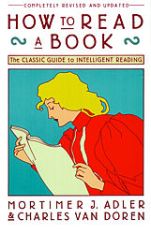
    ImageYou might ask yourself, how could anyone possibly fill 419 pages with instructions on how to read?

    The answer is quite easily, actually.

    First published in 1940, Mortimer J. Adler’s How to Read a Book became a best-seller, translated into at least 5 languages. It was substantially revised and expanded, with the help of Charles Van Doren, for its final publication in 1972.

    Adler was the chairman of the board at the pre-Wikipedia Encyclopedia Britannica and Van Doren is best known for his stint on the 1950s quiz show Twenty One, for which he would later admit to being given the answers in advance.

    The original book anticipated the post-War expansion of the public school system and growth in reading. It is designed as a supplement for those having a formal education and as a replacement for those going it on their own. It is chock full of good tips for readers and writers and teachers of reading and writing.

    One of its most basic lessons is the speed of reading. You’d expect that the authors would have an apoplectic reaction to the notion that any book could be read quickly. But that is hardly the case. Rather, Mortimer and Adler embrace fast reading. As they write, “Every book should be read no more slowly than it deserves, and no more quickly than you can read it with satisfaction and with comprehension” (43; emphasis removed). The trick, then, is not learning to read quickly; it’s knowing the speed at which a book demands. Most young people suffer from an inability to know what any particular book requires.

    Mortimer and Adler are not out to make every book a revelation and make every author a prophet. Books are intellectual offerings, to be examined, considered, and compared. There are bad books; in fact, most books are bad—or at least not very good. Most books should be skimmed, if they can’t be avoided.

    There are other pieces of writing, however, like the Declaration of Independence, that require a great deal of attention and reflection. “Properly read, for full comprehension, those first two paragraphs of the Declaration might require days, or weeks, or years,” they instruct (42). It is Jefferson’s list of infractions, which comprise the bulk of the document, that can be gone over quickly.

    How to Read a Book is also remarkable for its unapologetic modernism. Books are things to be understood. The idea that books can mean different things to different people doesn’t come till the seventh chapter, and even then it’s only in passing.

    “A book is something different to each reader,” they admit. However, that difference is not the goal; it is certainly not to be embraced. “This does not mean, however, that anything goes” (83). The point is to employ a rigorous and purposeful method to minimize the difference between readers and authors. The goal is not interpreting, but good ol’ fashioned understanding.

    Much to the confused chagrin of English faculty everywhere, the authors also caution against the “intentional fallacy”—that is, the idea that a reader can get into the head of an author based on what appears on the page (93).

    No doubt, Derrida is rolling over in his “grave.”

    Yet even as Mortimer and Adler seem inclined to reject postmodern deconstructionism as lazy and gross, they also want to rescue the relevance of theory. In their discussion of the difference between practical and theoretical texts, the authors identify John Locke’s Second Treatise on Government, a canonical piece of political philosophy and theory, as a practical text. Why? Because it tells you how you should form a government, silly. They offer up Kant’s Critique of Practical Reason as an example of a purely theoretical text because it is concerned with what is (ontology) and what we can know (epistemology).

    Mortimer and Adler deem comparative analyses—they call it “synoptical”—as the most difficult, which is consistent with what we have come to know  in the decades since the book appeared about how people learn.

    In addition to the reading comprehension quiz in the appendix, there is also a list of quality authors and texts, which will no doubt be met either with great excitement or great indignation.

    The issue, as you might expect, is not with what it includes, but what it excludes. (That said, the Greeks and Romans are a bit over-represented, and I would have preferred to have seen Nietzsche’s remarkable The Gay Science in place of The Will to Power, his unpublished notes.) As a fairly standard representation of the Western canon, it is very white and very male. It’s hard to imagine a list of essential fiction that does not include Willa Cather and Edith Wharton. And where is Steinbeck? It should also include Richard Wright’s Native Son, perhaps the best book on race that’s even been written. The book, published in 1940, was too early to make the first list, but it could have been added to Mortimer and Adler’s revised edition. The same goes for To Kill a Mockingbird, The Catcher in the Rye, All the King’s Men, Catch-22, and Slaughterhouse Five, books which might have been too new to be appreciated fully.

    Sadly, with the possible exception of Leo Strauss’s Natural Right and History, John Rawls’s A Theory of Justice, and, to a lesser degree, Richard Rorty’s Philosophy and the Mirror of Nature, there seems to be a serious dearth of non-fiction books to add to any post-1972 list of must-read texts.

    How to Read a Book is a book for everyone and no one. It is a practical book that deserves a slow read. It goes without saying that it should be required of all college students. But it first should be read by the professors who teach them.

←Previous Page
1 2

Website Built with WordPress.com.

  • Subscribe Subscribed
    • Steven Michels
    • Already have a WordPress.com account? Log in now.
    • Steven Michels
    • Subscribe Subscribed
    • Sign up
    • Log in
    • Report this content
    • View site in Reader
    • Manage subscriptions
    • Collapse this bar